
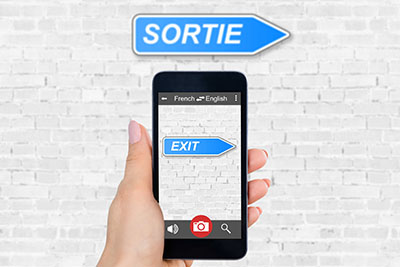
When we published the first version of this blog in 2019, Google Translate was the go-to free translation tool for most people. You'd paste in a sentence, get a rough translation, and move on with your day.
Since then, the landscape has changed significantly. ChatGPT, DeepL, and built-in translation features inside Slack, Zoom, and Google Docs have given people more free options than ever.
So is Google Translate still relevant? Yes, but the question has gotten bigger. The real question now is when any free AI translation tool can do the job and when you need a professional human translator who can convey nuance and meaning that automated tools can't.
Free AI translation tools work well for quick, low-stakes tasks
Google Translate and similar tools work great when you need a quick translation that doesn't need to be perfect. Think of them like a pocket calculator: great for splitting a dinner bill, but you wouldn't use one to file a corporate tax return.
A "fair approximation," however, obviously isn't the same as being accurate. Nothing quite compares to a professional translator, especially for important tasks like translating a website or localizing product documentation.
Google Translate may save the day for a traveler reading a menu, but the same can't be said for business content that your customers, partners, or regulators will read.
Free tools fall short where tone, culture, and context matter
AI translation tools have improved dramatically, but they still share the same core limitations. All of them analyze patterns in large amounts of text and predict the most likely translation for a given phrase. That approach handles straightforward content well, but it falls short in three areas that matter most for business communication.
1. Professional translators replicate tone and style that free tools flatten.
Every piece of writing has a specific voice, whether it's a marketing campaign, a legal disclaimer, or an employee benefits guide. Free AI tools don't detect or preserve those tonal differences. They produce generic, neutral output regardless of whether the original was formal, casual, urgent, or playful.
If you've ever read a translated website that felt flat or slightly off, that tonal flattening is likely the reason.
2. Professional translators understand culture in ways AI tools don't.
Cultural understanding remains one of the biggest gaps in AI translation. Expressions like "break a leg" or "back to square one" don't translate literally into other languages. Some tools, particularly ChatGPT, recognize common idioms better than Google Translate does. But the results are inconsistent, and a tool might handle an idiom correctly in one sentence and translate it literally in the next.
Professional translators who understand both cultures make deliberate choices so the translation feels natural to the target audience.
3. Professional translators connect words and context more reliably.
Context drives meaning in written language. Words often have multiple definitions, and picking the right one requires reading the full sentence or even the full paragraph.
The English word "crane" can refer to a bird, a piece of construction equipment, or the act of stretching your neck. A human translator reads the surrounding text and instantly picks the right meaning. Free AI tools sometimes guess wrong, especially in industry-specific content where a common word carries a specialized definition.
Legal, medical, and manufacturing content all use precise terminology where a single wrong word can change the meaning of a document. Even small translation mistakes can put product safety at risk when the content involves dosage instructions, warning labels, or regulatory filings.
Confident-looking mistakes are the biggest risk
One thing that's changed is that free AI tools now produce fluent, natural-sounding output. That improvement cuts both ways.
ChatGPT and DeepL return translations that read smoothly and look polished. If you don't speak the target language, you have no way to spot whether the translation says something subtly different from what you intended.
A professional translator catches those errors because they understand both languages and the subject matter. Free tools can produce confident-sounding translations that are actually wrong, and that false confidence is where organizations get into trouble. No AI translation tool delivers 100% accuracy, even the best custom-built systems, and any provider claiming otherwise is making the most dangerous promise in translation.
If you're also concerned about what happens to your sensitive content after you paste it into a public AI tool, the privacy and security risks of free AI translation are worth understanding before you hit translate.
AI translation with human review offers a middle ground
The choice used to be fairly binary: use Google Translate for free or hire a human translator. Today, there's a practical middle option.
Many translation providers now offer AI translation with human review, sometimes called machine translation post-editing (MTPE). An AI engine produces a first draft, and a professional linguist reviews, corrects, and refines the output.
The key difference between MTPE and pasting content into Google Translate is oversight. A qualified linguist checks every sentence against the source material and catches errors introduced by the AI. For organizations that need even more consistency, custom AI translation engines can learn your approved terminology and brand voice over time.
How to decide what your content needs
Google Translate and other free AI tools aren't going away, and they shouldn't.
Use a free AI tool when:
- You need to understand foreign-language content for your own reference
- The content is informal, and the consequences of an error are low
- You're scanning a competitor's website, reading foreign-language news, or getting the gist of a message
- No one outside your team will see the translation
Use professional translation or MTPE when:
- The content will be published, sent to clients, or used in a regulated setting
- Accuracy, tone, and cultural fit matter
- The content includes legal, medical, financial, or technical terminology
- A translation error could damage your brand, create compliance issues, or affect someone's safety
If you're unsure which approach fits, ask yourself: what happens if this translation is wrong? If the answer is "not much," a free tool is probably fine. If the answer involves lost business, legal exposure, or someone getting hurt, invest in professional translation.