


If you build training in Articulate 360, you can use Articulate Localization to machine-translate a Rise or Storyline course into more than 80 languages. For every course with a global audience, that gives your team a new choice: use the built-in AI, or send the course to a translation agency. The same choice applies to any authoring tool or LMS with its own AI translation feature.
The two paths differ in more than price. If you pick the AI for the wrong course, learners may get training they can't follow. If you send every course to an agency, you may pay professional rates for content the AI could have handled with a good review.
This post covers what the AI translates, how accurate it is in different languages, and who should review its output. It also covers when a course's content raises the stakes, the production work every translation needs, what each path costs, and the lock-in risks to check.
What Articulate Localization translates and what it leaves out
Articulate says its tool translates the on-screen text in Rise and Storyline courses, but several other parts of a course stay in the original language. Start by checking how much of your course falls outside its reach.
Articulate adds two controls to its machine translation. First, you can upload a glossary, a list of approved translations for key terms like product names, so the AI translates them consistently. Articulate's FAQ says glossaries currently work only on its course-based Localization plans, with support for credit-based translation coming soon. Second, reviewers called "validators" can check and fix the translation inside the course, and authors can import those fixes back into the project.
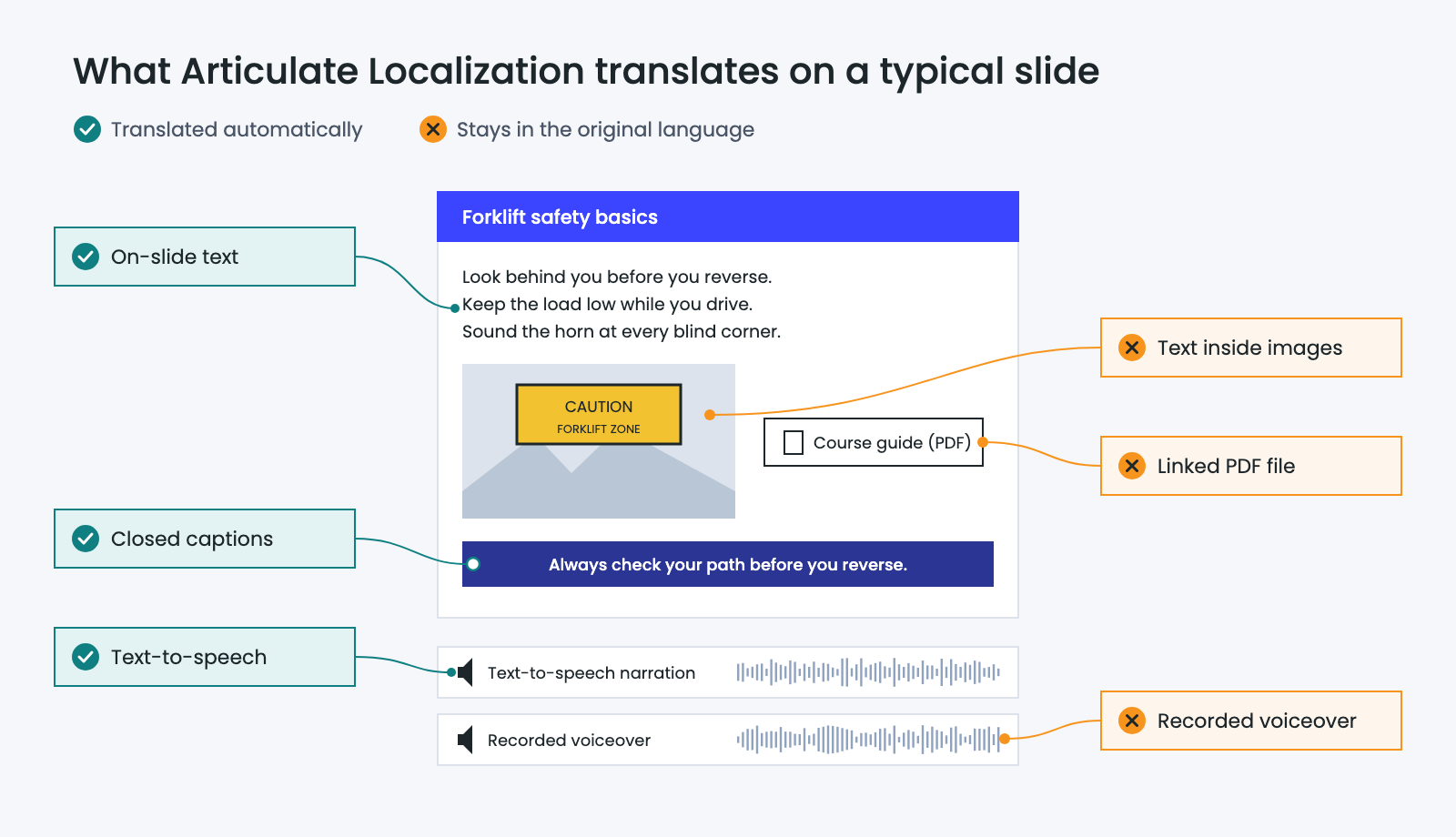
The tool translates these items on its own:
- On-slide text, slide notes, and text variable values in Storyline
- Block text in Rise
- Closed captions
- Text-to-speech narration
- Custom alt text, the description a screen reader reads aloud for an image
- Question banks
These items stay in the original language:
- Custom text labels and the app's default alt text
- Text inside images or video, media embedded from outside Articulate 360, and linked files like PDFs
- Storyline blocks placed inside a Rise course
- Recorded voiceover, which needs new recordings in each language
Support for glossaries, formal tone, and right-to-left languages also differs by language, so check each of yours with Articulate's language lookup tool.
If your course is mostly on-screen text, the tool can handle most of it, and how well it translates that text depends mostly on your target language.
How accurate AI translation is in different languages
In a 2025 study in JAMA Network Open, AI and professional translators made serious errors at the same rate in Spanish, but AI made far more in Chinese, Vietnamese, and Somali. Expert translators graded real hospital discharge instructions without knowing which version AI wrote. Here's the share of sections with errors serious enough to affect patient care:
|
Language |
AI translation error rate |
Professional translation error rate |
|
Spanish |
7% |
7% |
|
Simplified Chinese |
52% |
20% |
|
Vietnamese |
41% |
14% |
|
Somali |
92% |
13% |
The study tested an Azure AI engine on medical text, not Articulate's tool on training courses. The numbers won't carry over exactly, but they're a strong warning sign. A 2021 study in the Journal of General Internal Medicine found a similar pattern. Google Translate kept the meaning of 82.5% of emergency department instructions overall, but accuracy ranged from 55% to 94% depending on the language.
Languages less like English also take more work to fix. Translators call that fixing step post-editing, which means a person corrects the machine's output. The DivEMT study, presented at the EMNLP 2022 conference, found that these languages needed more post-edits on average. It also found that automatic quality scores poorly predicted how much editing a new language pair would need.
So when a tool supports 80+ languages, you get 80+ quality levels for the first draft. What learners finally see depends on who reviews that draft.
Who should review AI translations, and how much review is enough
A trained expert doing a full post-edit can bring machine translation up to the level of human translation. A quick or untrained review often can't. Treat the AI output like a first draft from a fast new hire. It saves you time, but someone who knows the language and the subject still needs to sign off before learners see it.
A 2024 study in Public Opinion Quarterly found no real difference in errors between translations people did alone and machine translations a person then post-edited. With only light post-editing, a quicker pass, the translation had more errors in one of the two languages the researchers tested.
The reviewer's experience matters too. A 2023 study in Humanities and Social Sciences Communications found that beginner translators missed too many machine errors. If you plan to use bilingual employees as Articulate validators, keep in mind that speaking two languages well doesn't give someone the training to spot translation errors.
The international standard ISO 18587 says a full post-edit must be accurate, clear, and well styled, and must read just like human translation. It also says a post-editor needs one of these:
- A degree in translation
- A degree in another field plus two years of full-time professional experience
- Five years of full-time professional experience
A related standard, ISO 17100, covers human translation and calls for a second person to revise the work. If a language service provider (LSP), or translation company, follows either standard, you can use it to compare the LSP's reviewers with your own. A qualified in-house reviewer keeps the AI path open for more of your courses.
When safety and compliance courses need a translation agency
If OSHA requires the training in your safety course, a bad translation can put you out of compliance. OSHA's guidance on training says employers must present required training "in a language and vocabulary that employees can understand." A machine-translated safety course that confuses workers may not count as OSHA-required training.
In medical, legal, and customer-facing courses, one mistranslated step can cause harm or trouble with regulators. For these courses, plan from the start for a translation agency to translate or fully post-edit the course in every language.
The layout, voiceover, and image work every translated course needs
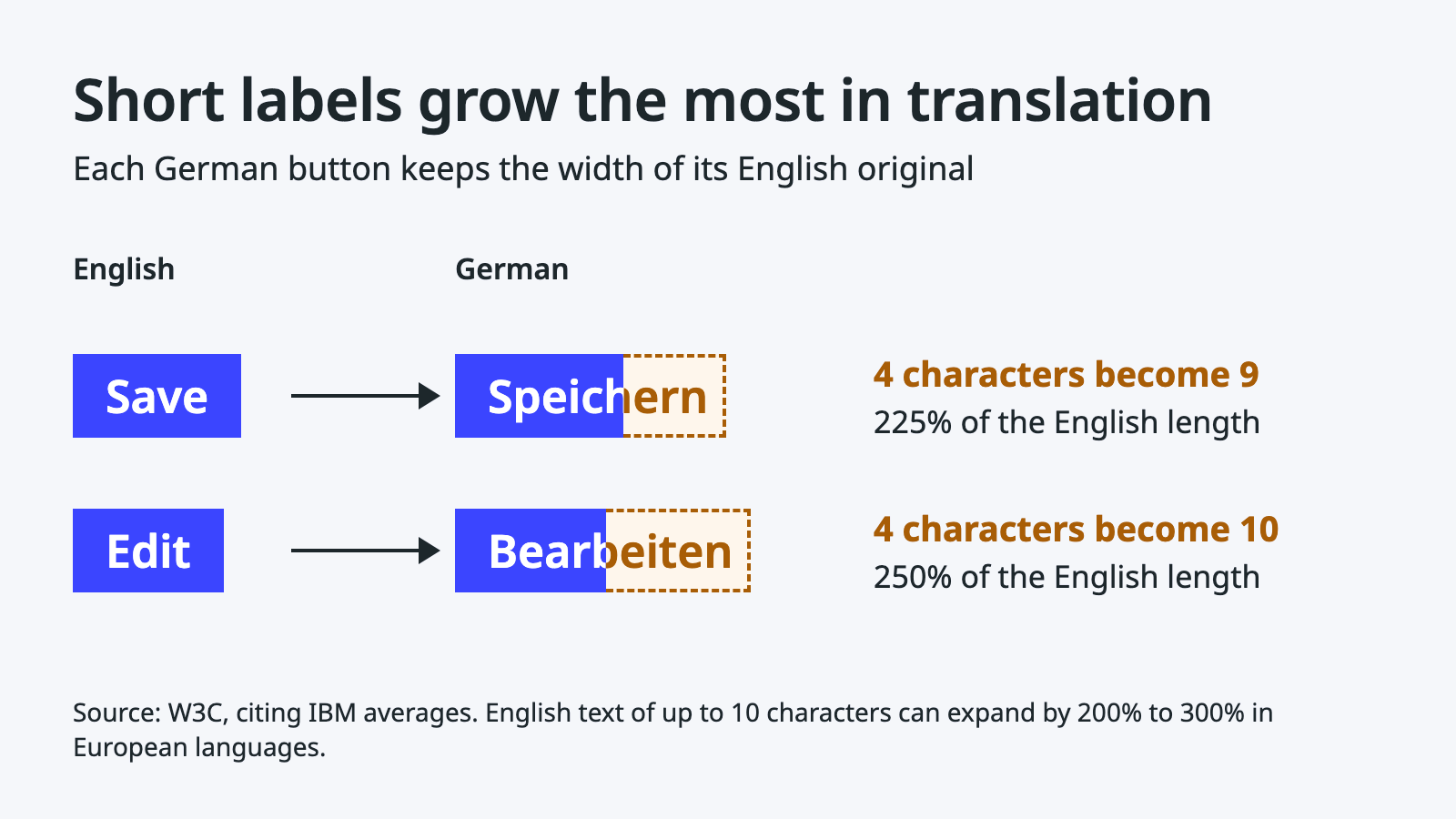
Whichever path you choose, every translated course needs a layout check, and every course with narration needs new timing. Translated text and speech rarely match the length of the English.
Short text grows the most. According to the W3C, IBM averages for English into European languages show that text of up to 10 characters can expand by 200% to 300%, and text of 11 to 20 characters by 180% to 200%. That's why buttons, tabs, and labels tend to break first.
Voiceover and images add manual work. TheEduAssist's Storyline localization guide says someone has to re-sync Storyline animations to the translated audio by hand. RWS, a language service provider, says that locking your voiceover scripts when you sign off on the English course is the best way to protect your voiceover budget. RWS also notes that you can't export text inside a Storyline image through XLIFF, a standard file format for moving course text into translation tools, so those images need their own translation step.
Articulate Localization leaves most of this work to your team, while a translation agency with multimedia experience can handle it for you. Either way, it adds to the cost, so include it when you compare prices.
What Articulate Localization costs compared with a translation agency
Raw machine translation through Articulate costs far less per language than human translation, but that price includes no human review. Articulate made big changes to its pricing and credit rules in September 2026, so confirm every number below with Articulate before you budget.
Articulate now sells translation through Nova credits. Its pricing page lists credits starting at $250 per 50,000, or half a cent per credit. That's on top of the Articulate 360 AI seat, which costs $1,749 per year on the Teams plan or $1,449 on the Personal plan. If you have an older Localization plan, you may still use that plan's own credits for Rise and Storyline courses, so check which kind your account uses.
Articulate's FAQ says translation uses 2 credits per source character for each target language, and Articulate estimates that rate at about $0.05 per word per language. An internal Articulate sales calculator uses a sample course length of 3,145 words. Here's what that sample course would cost per target language:
|
Approach |
Estimated cost per language |
What the price covers |
|
Articulate Localization credits |
About $150 to $190 |
Raw machine translation, with no human review |
|
Professional post-editing of machine translation |
About $330 |
A linguist corrects the machine's output |
|
Human translation |
About $600 to $1,730 |
Translation only, before course engineering, quality checks, or voiceover |
The post-editing estimate uses about $0.11 per word, converted from the UK average in a 2020 Nimdzi pricing study. The human estimate uses the $0.19 to $0.55 per word range in the University of Wisconsin-Madison Extension's budgeting guide. The Articulate row doesn't include your reviewer's time, and the other two rows don't include course engineering, testing, or voiceover.
Lock-in and data risks of Articulate Localization
The biggest risks of Articulate Localization show up after the first translation run. You can lose the option to import outside translations, a re-run can erase reviewed work, and when your plan or credits run out, you can lose the ability to publish or update translations.
Translation companies use XLIFF files to apply your translation memory, a database of your approved translations that they reuse on later work. Articulate's FAQ says you can't import XLIFF files into a multi-language course after translation. You can save each language as a separate course and use XLIFF there, but those copies lose validation and the other multi-language features.
An Articulate staff member said in 2025 that re-translating a course, such as after a glossary update, overwrites everything, including work your validators already approved. Articulate's FAQ now says it retranslates text updates segment by segment, so a change only retranslates the segments you edited. That may limit the problem, but test it on a copy first.
License lapses carry the most risk, and the rules depend on your plan. On Articulate's older course-based plans, the FAQ says you keep your content when the plan ends but can't publish translated versions, and any updates you publish include only the source language. That matches what one customer described in Articulate's Licensing Trap forum thread. After their Localization license lapsed, they couldn't export a translated course as a single-language SCORM package, the standard file format most learning systems use. With credit-based translation, the FAQ says you can still publish existing translations, but you can't translate new content or updates once your credits run out or expire. Before you commit, ask Articulate to confirm in writing which rules apply to your plan.
Also, check how your data is handled. According to Articulate's FAQ, the tool sends course text to DeepL, Amazon Web Services (AWS), or Google Cloud, encrypts it in transit, doesn't keep it after translation, and never uses it to train AI. The exception is your glossary, which Articulate stores for the length of your subscription. These assurances come from the vendor, not an outside audit, so check them with your security team before you translate sensitive content.
None of these risks rule out the AI path. They do change how you set it up, and they're a good reason to test the tool on one of your courses before you sort your whole catalog.
When to use Articulate Localization and when to use a translation agency
Use Articulate Localization, or a similar built-in AI tool, when a course passes all four of these tests:
- It's internal and low-risk.
- It's mostly on-screen text.
- It's going into a widely used language like Spanish.
- A qualified reviewer can check it in context.
Use a translation agency when a course covers safety, compliance, legal, medical, or customer-facing content, when your target language is less like English, or when the course relies on voiceover, video, or text in images. For courses that go into many languages and change often, try a hybrid: AI writes the first draft and a professional post-edits it, so you keep most of the speed and still get a full review. Here's how common course types line up:
|
Course type |
Better fit |
Why |
|
Internal, low-risk, text-heavy courses (soft skills, culture, onboarding) in widely used languages like Spanish |
Articulate Localization plus a qualified in-context reviewer |
The quality gap is smallest in these languages, and speed, single-package publishing, and in-context review are real advantages |
|
Safety, compliance, legal, medical, or customer-facing courses |
An LSP using ISO 17100 translation or ISO 18587 full post-editing |
Errors carry regulatory or harm risk, and a light review doesn't match full post-editing |
|
Languages less like English, such as Somali, Vietnamese, or Chinese |
An LSP, or at least a professional post-editor |
Machine translation errors rise sharply |
|
Voiceover-heavy Storyline courses, text in images, embedded PDFs, or video |
An LSP or multimedia specialist |
The AI tool doesn't translate these items |
|
Many languages with frequent updates |
A hybrid: Articulate's machine translation with an LSP post-editing in Review 360, or the LSP's translation memory through XLIFF |
Translating only changed text helps, but lock-in and losing the XLIFF route are real risks |
|
Tight budget and small volume |
AI translation, or DeepL through XLIFF, plus an internal subject-matter expert |
Lowest cost, but you accept the quality risk |
If you choose the hybrid, ask providers how they pair AI translation engines with human post-editing. If your authoring tool or LMS has its own AI translator, the table still works; swap in that tool's answers on scope, pricing, and export terms.
If your pilot or the table points some courses toward an agency, Argo Translation can review your content and recommend how to handle each one, whether that means full translation, professional post-editing of AI output, or new voiceover. Argo Translation is certified to both ISO 17100 and ISO 18587, the two standards this post uses to judge reviewers, and a dedicated project manager coordinates the work from start to finish.